Common Wood-Pigeon
Columba palumbus
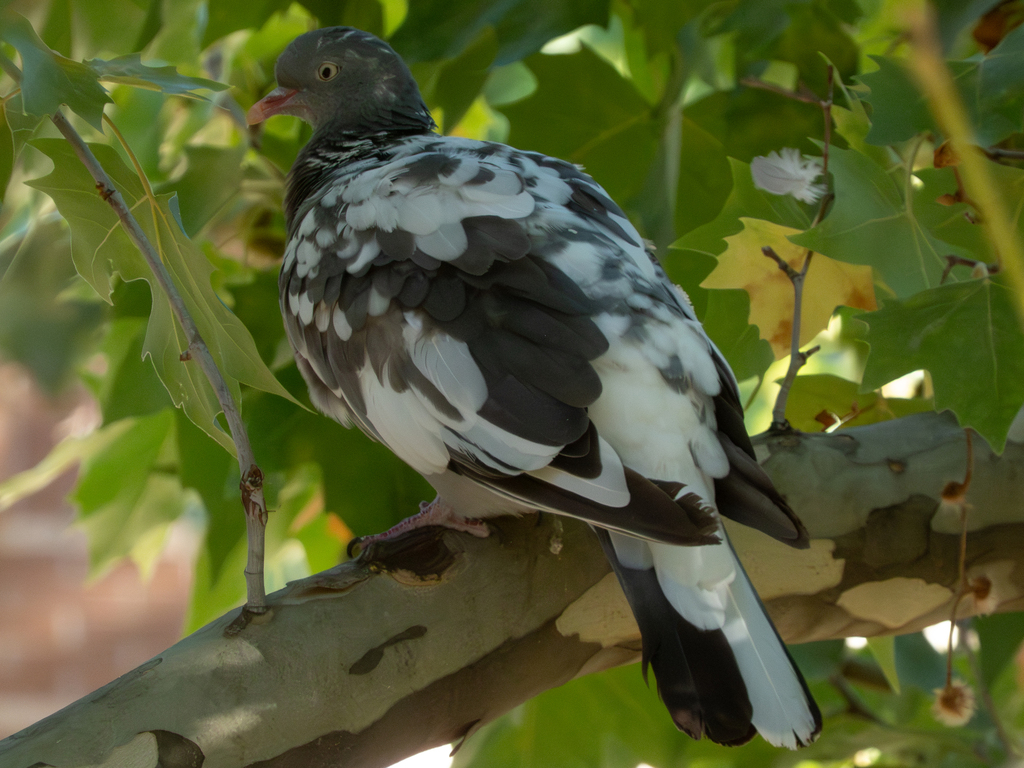
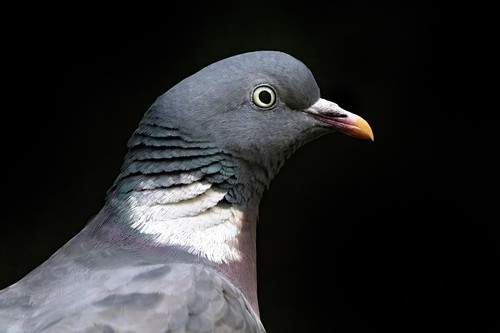
Large grey pigeon with a pinkish breast, white neck patches and bold white wing bars visible in flight.
- Family
- Columbidae
- Order
- Columbiformes
- Size
- 38–44.5 cm long · 75–80 cm wingspan
- Status
- Native in United Kingdom
- Records
- 151,779
- Peak
- Apr · Mar · May
How to recognise
What you are looking at
Large grey pigeon with a pinkish breast, white neck patches and bold white wing bars visible in flight.
Typical size: 38–44.5 cm long · 75–80 cm wingspan
Habitat & behaviour
Where it lives
Parks, gardens, farmland and woodland edges; nests in trees and on buildings.
How it behaves
Feeds on the ground in groups, clatters up noisily when disturbed and gives a five-note coo.
Diet & timing
What it eats
Seeds, grain, buds, leaves and berries.
When to look
Early morning feeding; display flights and cooing peak in spring.
Field tip
The white wing bars are the fastest way to separate it from the rock pigeon in flight.
Seasonality
When it shows up
November: good chance
Where to look
Places with recent records
Ancient woodland, acid grassland, deer
Richmond Park
The largest of London’s royal parks: 2,500 acres of open grassland, veteran oaks and free-roaming red and fallow deer.
Woodland, ponds, rough grass
Hampstead Heath
A wild-feeling ridge of woods, ponds and meadows ten minutes from Zone 1, with one of the city’s richest bird lists.
Lake, lawns, ancient trees
Hyde Park
The Serpentine and its margins are the classic introduction to London’s waterfowl, herons and winter gulls.
Reservoirs, reedbed, scrub
Walthamstow Wetlands
Europe’s largest urban wetland nature reserve — a working reservoir estate that doubles as a migration hotspot.
Botanical collections, lake, woodland
Kew Gardens
A living collection of more than 27,000 plant taxa, with mature trees, a lake and long-established woodland edges.
Lake, lawns, waterfowl
St James’s Park
The oldest of London’s royal parks, and the easiest place to meet pelicans, herons and a very confiding waterfowl flock.
Easy to confuse with
Similar species in London



Also recorded in
The same species elsewhere
Questions
Common Wood-Pigeon in London
- Where can I see Common Wood-Pigeon in London?
- Common Wood-Pigeon has recent records at Richmond Park, Hampstead Heath, Hyde Park. Check each park page for habitat notes and access.
- When is the best time to see Common Wood-Pigeon in London?
- Records peak in April, March, May. In November, activity is rated “good chance”.
Sources
Occurrence counts and seasonality are derived from GBIF records (2018–2026). Description adapted from Wikipedia via iNaturalist, licensed CC BY-SA. Photo credits appear under each image. Native or introduced status comes from iNaturalist regional checklists. Species pages are for observation only — never disturb wildlife.